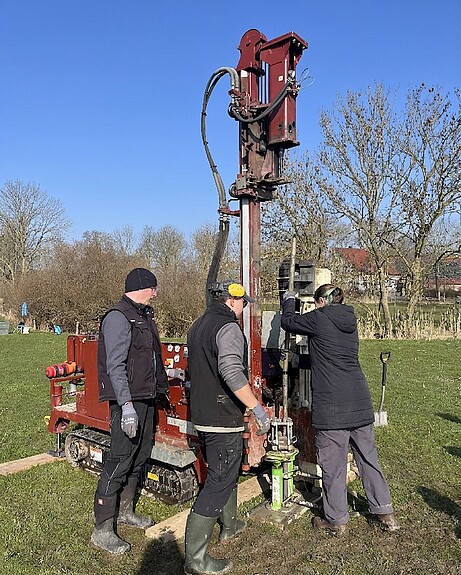
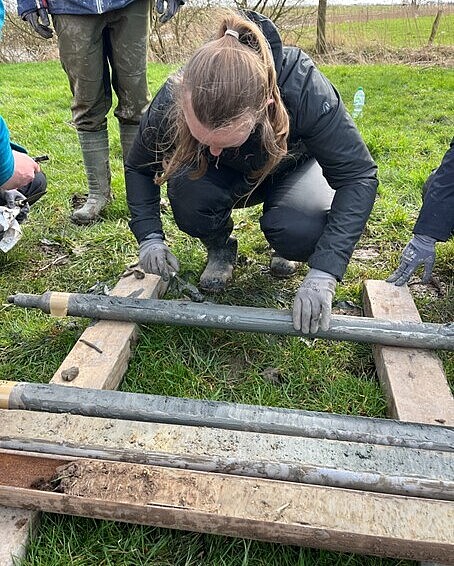
To uncover the history of the palaeolandscape, geological samples are indispensable. In mid-March, the WP6 team set out for Neuharlingersiel to conduct a coring campaign. Researchers and students from the University of Mainz (working group Geomorphology) also joined the campaign, contributing valuable expertise and excellent field equipment to support CoastAdapt.
As part of a field training exercise, the Mainz colleagues offered students the opportunity to directly experience the practical aspects of scientific coring in the field. In addition to the field activities, Dr. Ines Bruns gave students an overview of the goals of CoastAdapt and the geological setting of the Lower Saxony coast. A key highlight was that the collected data are directly incorporated into current research.
Within the campaign, two sediment cores were recovered. The aim was to capture the complete Holocene coastal sediment succession. Of particular interest is a peat horizon containing so-called Klappklei layers: Sedimentary deposits formed by storm surges prior to the construction of coastal dikes.
In the coming months, these storm-surge deposits will be dated. This will allow us to reconstruct when past storm surges shaped the coastal landscape and how they influenced environmental conditions before the establishment of dike systems. The new sediment cores thus provide valuable insights into coastal evolution and the dynamics of past extreme events.