
Excited to share our latest publication on “Structure-induced turbulent upwelling and sediment mobilization in a modified tidal inlet”, just published in Continental Shelf Research.
How do large coastal engineering structures alter the system-scale sediment dynamics of a tidal inlet, especially under extreme forcing? By combining aerial imagery with spatially paired ADCPs upstream and downstream of a large-scale groyne, we were able to isolate and quantify complex fluid-structure-sediment interactions.
Key highlights from the study:
- Unparalleled storm dataset: We captured unique tidal hydrodynamics before, during, and after intense storm conditions. Thus, providing the first explicit differentiation between episodic storm responses and recurring tidal processes at groyne-scale structures.
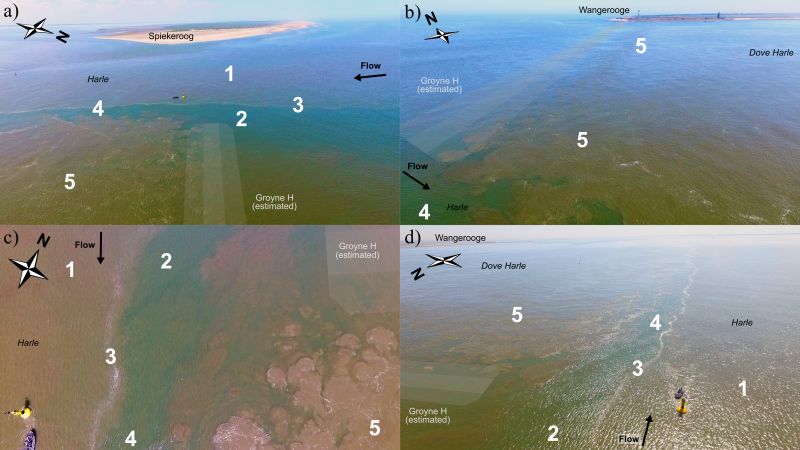
- Linking patterns to physical processes: We quantified five distinct surface turbidity patterns, linking them to subsurface hydraulic processes, which are recurrent features of the tidal forcing.
- The “hydrodynamic chain”: Using Reynolds stresses, we reliably detected a distinct downstream mechanism where submerged groyne overflow initiates a near-bed roller and subsequent turbulent upwelling.
- Engineering implications: This structure-induced transport is not just a localized anomaly. It accounts for a significant share of the inlet’s overall sediment budget and continues to drive long-term groyne-induced scour.
The study was part of the projects “Gute Küste Niedersachsen”, and “CoastAdapt”, both funded by the Niedersächsisches Ministerium für Wissenschaft und Kultur.
Read the full open-access paper here: Herbst, M., Visscher, J., Lojek, O., & Schlurmann, T. (2026). Structure-induced turbulent upwelling and sediment mobilization in a modified tidal inlet. Continental Shelf Research, 301(105718), 105718. doi:10.1016/j.csr.2026.105718